The Department of Obstetrics & Gynaecology and the Department of Paediatrics, K.V.G. Medical College & Hospital, Sullia, in association with the Indian Medical Association, Sullia Branch, organised a Breastfeeding Awareness Programme on the occasion of World Breastfeeding Week 2026 on 5th August 2026 at 11:00 AM, near the Ganesha Statue, KVGMCH, Sullia. World Breastfeeding Week is observed globally from 1st to 7th August every year, and the theme for 2026, “Breastfeeding for a Sustainable Start in Life: Strengthen What Works”, emphasises the strengthening of the warm chain of support for breastfeeding across health systems, workplaces, communities and families. The programme was attended by antenatal and postnatal mothers, their family members and attenders, nursing students, interns and postgraduates.
The programme commenced with an invocation, followed by the lighting of the lamp by the dignitaries. Dr. Anil Baipadithaya delivered the welcome address.
Dr. Neelambikai Natarajan, Dean, KVGMC&H presided over the gathering and highlighted the institutional commitment to maternal and child health.
Dr. Geeta Doppa, Professor and Head, Department of Obstetrics & Gynaecology and Honorary Secretary, IMA Sullia, delivered a talk in Kannada on the topic “Why Breastmilk is the Best Gift for Every Baby”, emphasising that breast milk is the first right of every child. She explained the composition of breast milk and the manner in which it changes from colostrum to transitional and mature milk to suit the changing needs of the growing infant, and described colostrum as the infant’s first immunisation on account of its rich content of antibodies, white cells and vitamin A. She stressed the importance of initiating breastfeeding within the first hour of birth, of skin-to-skin contact and rooming-in, and of exclusive breastfeeding for the first six months without water, honey, sugar water or any prelacteal feeds. She outlined the protection that breast milk affords the infant against diarrhoea, respiratory infections, otitis media and neonatal sepsis, its contribution to optimal growth and neurodevelopment, and its role in reducing infant and under-five mortality, as well as the long-term protection it offers against obesity, hypertension and diabetes in later life. She further described the benefits accruing to the mother, including better uterine involution and reduced postpartum haemorrhage, lactational amenorrhoea as a natural method of birth spacing, earlier return to pre-pregnancy weight, and a reduced lifetime risk of carcinoma of the breast and ovary. She also spoke of the emotional bonding fostered between mother and child, and of the fact that breast milk is safe, hygienic, always available at the correct temperature and free of cost, making it the most sustainable form of infant nutrition for every family.
Dr. Sunitha then delivered a talk in Kannada on correct breastfeeding techniques and solutions to common problems. She demonstrated the various positions for breastfeeding, including the cradle, cross-cradle, side-lying and football holds, the last two being of particular value to mothers who have undergone caesarean section, and explained the four key points of good positioning, namely that the infant’s head and body are in a straight line, the body is held close to the mother, the infant is supported at the head, shoulders and buttocks, and the infant faces the breast with the nose opposite the nipple. She described the signs of good attachment as a widely opened mouth, an everted lower lip, the chin touching the breast and more areola being visible above than below the mouth, and contrasted these with the signs of poor attachment that lead to sore nipples and inadequate milk transfer. She explained feeding on demand, both by day and by night, the importance of emptying one breast before offering the other so that the infant receives the hind milk, and correct burping after feeds. The indicators of adequate feeding were described, including six or more wet nappies in twenty-four hours, satisfactory weight gain, and a contented and settled infant after feeds. She also demonstrated the technique of manual expression of breast milk, together with the correct method of storing and using expressed milk, and cup feeding in place of bottle feeding. In the latter part of her talk she addressed common problems encountered in the postnatal period and their remedies, including flat and inverted nipples, sore and cracked nipples, breast engorgement, blocked ducts and mastitis, and perceived insufficiency of milk, reassuring mothers that the great majority of women produce sufficient milk provided that the infant is correctly attached and fed frequently, and that the mother is adequately nourished, hydrated and rested. She concluded by advising mothers to seek help early from the hospital lactation services rather than resorting to formula feeds.
Dr. Ravikanth G. O., Professor, Department of Obstetrics & Gynaecology and President, MOGS, spoke on the myths and facts regarding breast milk, breastfeeding for working mothers, and the timely introduction of appropriate complementary feeding after six months with continued breastfeeding up to two years and beyond.
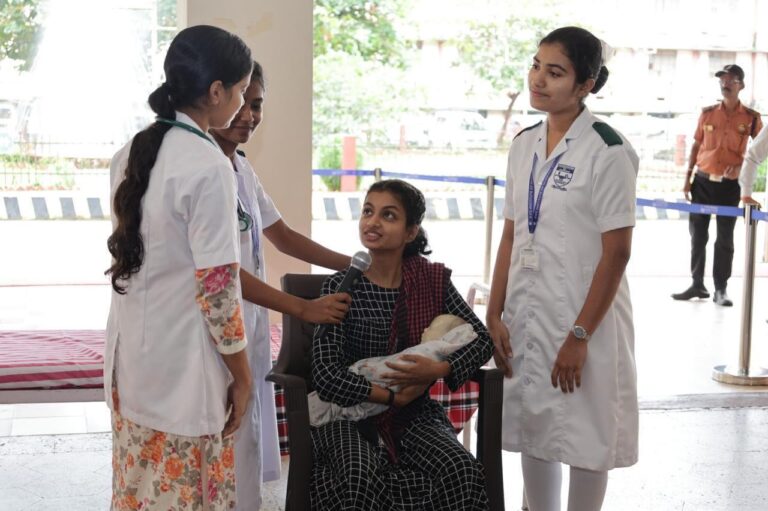
The students of KVG Institute of Nursing presented a skit on the myths and the importance of breastfeeding. The skit portrayed a newly delivered mother receiving conflicting advice from family members and neighbours, and depicted several prevalent misbeliefs, among them the notions that colostrum is impure and should be discarded, that prelacteal feeds such as honey, sugar water and plain water are necessary, that the infant requires additional water in hot weather, that a mother with small breasts or one who has undergone caesarean section cannot produce enough milk, that breastfeeding should be stopped when the mother or the infant is unwell, and that a working mother must necessarily switch to formula feeds. Each of these was answered in the course of the skit by a health worker character, who explained the value of colostrum, the sufficiency of exclusive breastfeeding for the first six months, the practice of expressing and storing breast milk for a working mother, and the supportive role that the husband, mother-in-law and other family members must play in the success of breastfeeding. The message was conveyed in Kannada in a simple and humorous manner and was very well received by the audience.
An interactive session followed, in which mothers and family members clarified their doubts regarding infant feeding practices, and information, education and communication material was distributed to the participants. The programme concluded with a vote of thanks proposed by Dr. Fathimath Hasreena.
The programme resulted in increased awareness among antenatal and postnatal mothers regarding early initiation of breastfeeding and exclusive breastfeeding for the first six months, improved understanding of correct positioning, attachment and technique and of common lactation problems and their remedies, clarification of prevalent myths and misconceptions regarding breast milk and infant feeding, and sensitisation of family members and attenders to their role in supporting the breastfeeding mother. It further reinforced the departmental and institutional commitment to Baby-Friendly Hospital Initiative practices and to the WHO and UNICEF guidelines on infant and young child feeding. The Breastfeeding Awareness Programme was thus successfully completed with active participation from mothers, family members, nursing students and departmental faculty, and met its stated objective of promoting, protecting and supporting breastfeeding in accordance with the theme of the year, thereby strengthening the continuum of lactation support extended by the institution to mothers in the community.